If your the Houston area home is raised on piers, water can collect in the crawl space after a plumbing leak or a heavy storm. It often goes unnoticed until the floor feels soft or the house smells damp.
The crew pumps out standing water, pulls down soaked insulation, replaces damaged vapor barrier and runs drying equipment until the joists and subfloor test dry. Wet materials should be dried within 24 to 48 hours[EPA].
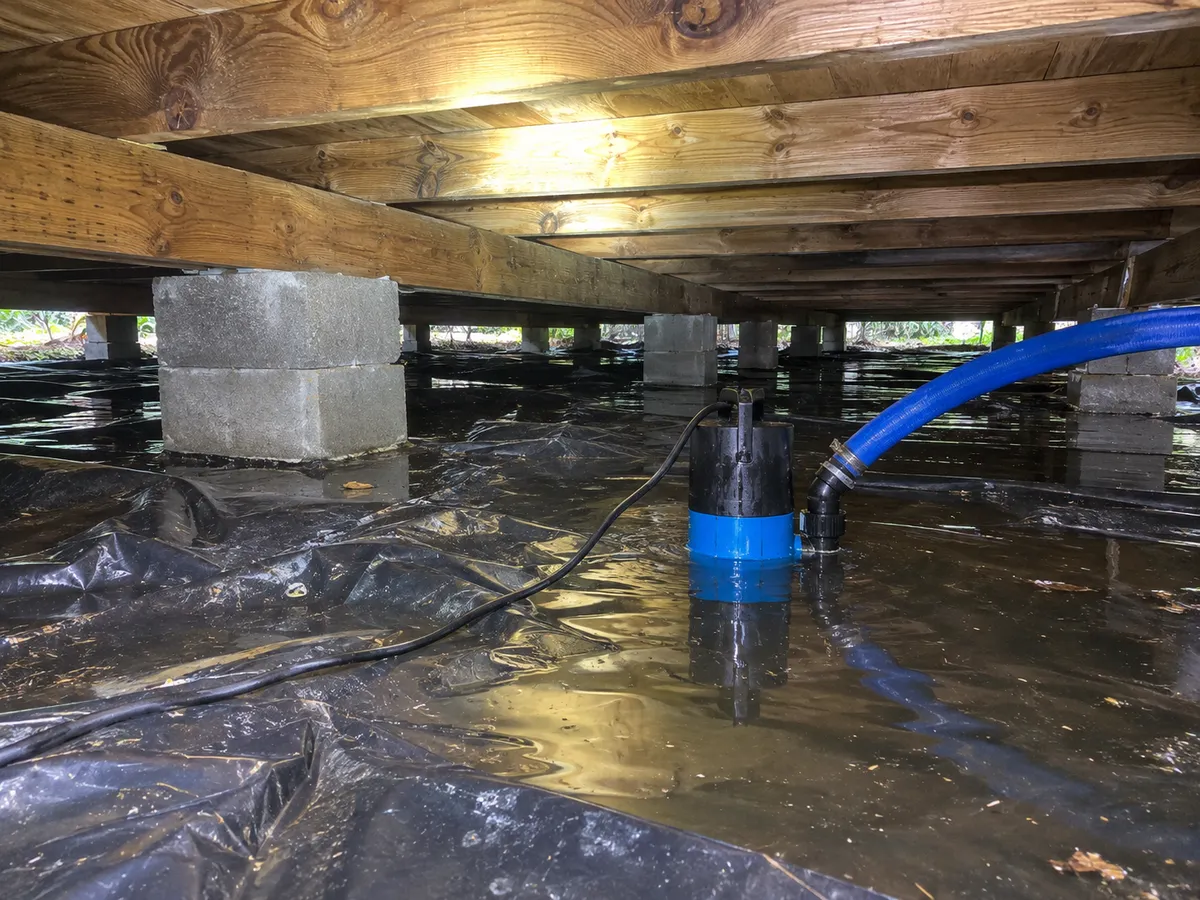
Typical steps
- Find the source. Plumbing leak, drain line or surface water.
- Pump out. Pooled water goes out through a sump or submersible pump.
- Remove wet materials. Insulation and vapor barrier that will not dry.
- Dry under the house. Dehumidifiers until readings show dry.
Do
- Turn off water if a plumbing leak is the source.
- Keep the crawl space access closed between visits.
Avoid
- Crawling into standing water near wiring[CDC].
- Leaving wet insulation hanging on the joists.
Inside a water damage restoration job in Houston
A water damage restoration job in Houston follows a set order. Each stage depends on the one before it, so the work is planned before the equipment comes off the truck.
- Inspection and moisture mapping. Moisture meters and thermal cameras trace water under flooring, inside walls and in ceilings, and the crew confirms the source is stopped.
- Water removal. Standing water comes out first, with pumps for deep water and extraction wands for carpet and tile, so drying equipment is not fighting a puddle.
- Removal of what cannot dry. Materials that will not dry in time are cut out. The EPA flood guide draws the line at 24 to 48 hours: if a wet material cannot be cleaned and dried by then, it is tossed[EPA flood cleanup guide].
- Structural drying. Dehumidifiers and air movers run in a closed space, and the goal is relative humidity under 60 percent, ideally 30 to 50 percent[EPA].
- Cleaning. Surfaces touched by contaminated water are cleaned and disinfected. The CDC says to throw away items that cannot be disinfected, such as wall coverings, cloth, rugs and drywall[CDC].
- Final readings. Equipment stays until moisture readings in the walls, subfloor and framing return to normal, and those readings are written down.
Leaks you cannot see in a Houston house
Most homes around Houston are built on concrete slabs, so water does not drain into a crawl space. It spreads sideways under baseboards, cabinets and flooring into the next room. That is why the wet area on the meter is often larger than the wet area you can see.
The AC system is easy to overlook. A clogged condensate line backs up the drain pan, and the EPA says pans that do not drain can let water into the HVAC system[EPA]. Keep the pan clean and the line flowing[EPA], especially when the unit is in the attic over finished rooms.
Places to check:
- Inside walls around leaking or sweating pipes[EPA]
- Under vinyl plank, laminate and carpet pad
- Behind the refrigerator ice maker line and dishwasher
- Under the water heater and washing machine
- Wall surfaces behind furniture, where condensation forms[EPA]
- Roof materials above ceilings after a roof leak[EPA]
Watch for a damp smell, baseboards that swell, stains that grow, floors that cup or buckle, and a water bill higher than normal.
Drying time and what speeds it up
Small leaks found early dry in days; whole-house floods take longer, and the EPA says the drying-out process after a flood could take several weeks[EPA flood cleanup guide]. Either way, the work should start within 24 to 48 hours[EPA].
Humid outdoor air works against you. The EPA’s guidance is to dehumidify when outdoor air is warm and humid, and to ventilate only when outside air is cold and dry[EPA]. On most days in Houston that means keeping windows closed and letting the dehumidifiers work.
Keep the equipment on and in place. Each time it is turned off, the air gets damp again and drying slows down.
When a storm knocks out power in Houston
Beryl came ashore near Matagorda on July 8, 2024 as a Category 1 hurricane with 80 mph winds, dropping around 4 to 8 inches of rain on average and 10 to 15 inches in some swaths[NWS]. CenterPoint’s tracker showed more than 2.2 million homes and businesses without power[Houston Public Media].
An outage matters for water damage because dehumidifiers and air movers need electricity, and without air conditioning indoor humidity climbs quickly. Restoration crews often bring generators to keep drying on schedule.
Generator safety: never run a generator inside the home or garage, keep it at least 20 feet from windows, doors and vents, and use a battery-powered carbon monoxide detector[CDC]. After Beryl, the NWS counted two indirect deaths from carbon monoxide poisoning[NWS].
Toilet and drain backups
Sewage is Category 3 water[IICRC 2026 position statement]. Keep children and pets out of the area, do not run fans that blow air from the wet room into the rest of the house, and do not try to dry it in place. Soaked carpet, pad and drywall are removed and the area is cleaned and disinfected before drying.
A plumber or your utility handles the blockage itself. The restoration company handles the water that came into the house.
Re-entering a flooded Houston home
Turn around at flooded roads. Six inches of fast-moving water can knock an adult down, and 12 inches of rushing water can sweep away most cars, according to the NWS[NWS].
With water in the house, turn off power at the breaker if you can do it safely, and disconnect appliances before power is restored[CDC]. Document the damage with photos before anything is moved[FEMA].
What usually causes water damage in Houston
- Supply lines. Braided and plastic supply lines under sinks and toilets fail at the connection. A failed line can run at full pressure until the valve is closed.
- Water heaters. When the tank or fittings leak, water spreads across the slab from the garage, closet or utility room.
- Washers. Old rubber hoses split, and a washer drain that backs up puts dirty water on the floor.
- Air conditioning. Condensate lines clog and drain pans overflow, especially in long cooling seasons.
- Kitchen appliances. Ice maker lines and dishwasher hoses leak out of sight under the cabinets.
- Weather. Heavy rain, roof leaks and street flooding. Wind-driven rain that is contaminated counts as Category 3 water[IICRC 2026 position statement].
The source matters because it sets the water category and the starting point for moisture mapping.
After the drying equipment leaves
Keep the final moisture readings and the drying log with your photos. Check the area again over the next few weeks for odors, stains or swelling, which can mean water was missed. The EPA notes that cleanup is not finished until the water or moisture problem itself is fixed[EPA].