When water is standing on the floor, the clock starts. Crews doing emergency water removal in the Houston area use pumps for deep water and extraction units for carpet and pad, because the EPA advises drying wet materials within 24 to 48 hours[EPA].
Most Houston-area homes sit on a slab, so water spreads sideways under baseboards and into the next room instead of draining away. The crew works outward from the wettest area and checks walls with moisture meters, not just by touch.
Typical steps
- Stop the water. Close the main shut-off or the valve at the fixture.
- Make it safe. Turn off power to wet rooms only if you can reach the panel without standing in water[CDC].
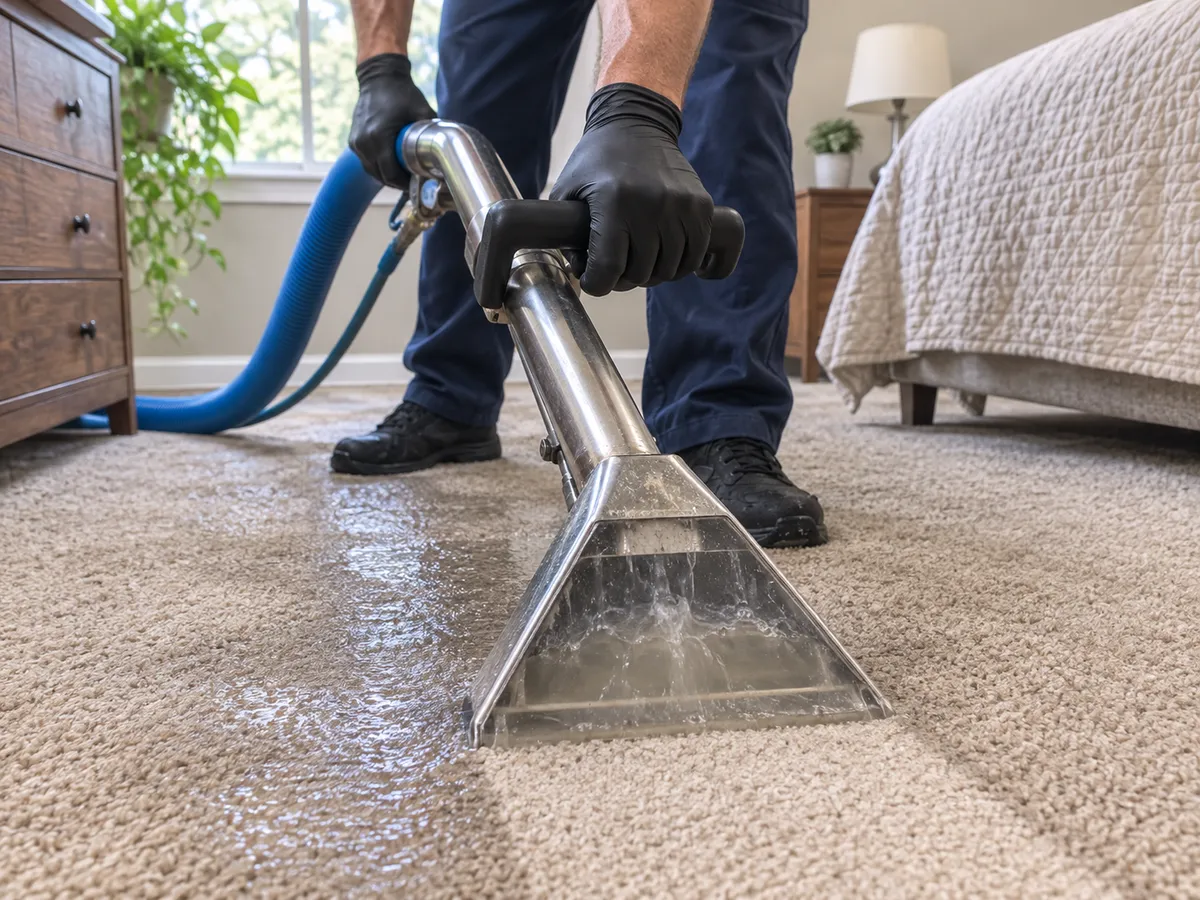
- Pump and extract. Pumps for deep water, extraction wands for carpet and pad, squeegees for tile.
- Set drying. Air movers and dehumidifiers go in once standing water is gone.
Do
- Photograph each room before anything is moved[FEMA].
- Lift furniture onto blocks or foil to protect legs and carpet.
Avoid
- Using a household vacuum on standing water.
- Walking through water near outlets or extension cords[CDC].
Water categories and why they change the job
The IICRC splits water into three categories. Category 1 is clean water from a source like a burst supply line. Category 3 is grossly contaminated, and the IICRC lists sewage, waste line backflows from beyond a trap, seawater flooding, rising rivers or streams and contaminated wind-driven rain as examples[IICRC 2026 position statement]. Category 2 sits in the middle.
It also changes how the crew works. With Category 2 or 3 water, removal and cleaning happen first, under contamination controls, and drying comes after; Category 1 can go straight to drying[IICRC 2026 position statement]. Floodwater from a Houston creek or bayou is Category 3.
Time matters too. The IICRC notes that time and temperature can change the category[IICRC 2026 position statement], so a clean leak left sitting in a warm house can be treated as contaminated water a few days later.
Hidden water: the spots crews check first
On a slab foundation, which is common around Houston, water moves outward under walls and cabinets instead of draining down. A leak in a hall bath can show up as a damp closet two rooms away.
Air conditioning is a frequent source. The EPA advises keeping AC drip pans clean and drain lines unobstructed and flowing[EPA], and notes that pans which do not drain can let water into the system[EPA]. When the air handler sits in the attic, an overflowing pan usually shows up first as a ceiling stain.
Places to check:
- Inside walls around leaking or sweating pipes[EPA]
- Under vinyl plank, laminate and carpet pad
- Behind the refrigerator ice maker line and dishwasher
- Under the water heater and washing machine
- Wall surfaces behind furniture, where condensation forms[EPA]
- Roof materials above ceilings after a roof leak[EPA]
Watch for a damp smell, baseboards that swell, stains that grow, floors that cup or buckle, and a water bill higher than normal.
What can be saved and what usually goes
The deciding factors are the type of water and how long things stayed wet. Under the EPA flood guide, if something cannot be cleaned and made dry inside a day or two, it is discarded[EPA flood cleanup guide], and the CDC adds that items which cannot be disinfected, such as wall coverings, cloth, rugs and drywall, should be thrown away[CDC].
Clean-water losses give you more options. The EPA says drywall, fiberglass insulation and carpet soaked only with clean water can sometimes be dried and kept, but it also suggests considering replacement because they dry slowly[EPA flood cleanup guide].
Take photos and video of damaged items before they are removed[FEMA].
Hurricanes, power outages and drying
Hurricane Beryl made landfall near Matagorda as a Category 1 hurricane early on July 8, 2024, and brought widespread power outages to the region[NWS Houston/Galveston]. More than 2.2 million homes and businesses lost power, based on the CenterPoint outage tracker[Houston Public Media].
Drying equipment runs on power. When the grid is down, a soaked house sits in heat and humidity, so ask whether the restoration company can bring generator power for its equipment.
If you use a generator, keep it outdoors, at least 20 feet from doors, windows and vents, never in the garage, and run a battery carbon monoxide detector inside[CDC]. Carbon monoxide caused two indirect deaths after Beryl[NWS].
Talking to a Houston restoration company
- What category is the water, and how does that change the plan?
- Where did the moisture meter show water, and how far did it spread?
- What needs to be removed, and why can it not be dried?
- How many dehumidifiers and air movers will run, and how often will someone check readings?
- Will I get a written scope and daily drying logs?
- Are the technicians on this job IICRC-certified?
A good restoration company will answer these without hesitating and will take readings before giving a plan.
Flood safety first
Do not walk or drive through floodwater. The National Weather Service says 6 inches of fast-moving water can knock over an adult and 12 inches of rushing water can carry away most cars[NWS].
If there is standing water inside, be ready to turn off the power, and unplug appliances so they do not shock anyone when power returns[CDC]. Take photos and video of every room before cleanup starts[FEMA].
Water removal and drying equipment used in Houston
- Moisture meters. Pin and pinless meters read moisture in drywall, wood and subfloor so the crew can map the wet area and track progress.
- Thermal cameras. Infrared cameras show temperature differences that often point to wet areas behind walls and under floors. Readings are confirmed with a meter.
- Extraction units. Truck-mounted and portable extractors pull water from carpet and pad; submersible pumps handle deeper water.
- Air movers. High-velocity fans move air across wet surfaces so moisture evaporates faster.
- Dehumidifiers. Refrigerant and desiccant dehumidifiers pull that moisture out of the air so it does not soak back into the house.
- Wall cavity drying. Small holes or removed baseboards let air reach the inside of wet walls without tearing out the whole wall.
After the drying equipment leaves
Keep the final moisture readings and the drying log with your photos. Check the area again over the next few weeks for odors, stains or swelling, which can mean water was missed. The EPA notes that cleanup is not finished until the water or moisture problem itself is fixed[EPA].