Emergency water removal, room by room
Emergency water removal in Atascocita means pulling standing water out before it soaks into drywall, cabinets and baseboards. The EPA’s guidance is to remove standing water quickly and dry wet materials within 24 to 48 hours[EPA].
On a slab floor, water does not drain down; it travels under walls and cabinets. That is why removal starts at the source room and works out, with moisture readings taken in the rooms next door.
Step by step
- Stop the water. Close the main shut-off or the valve at the fixture.
- Make it safe. Turn off power to wet rooms only if you can reach the panel without standing in water[CDC].
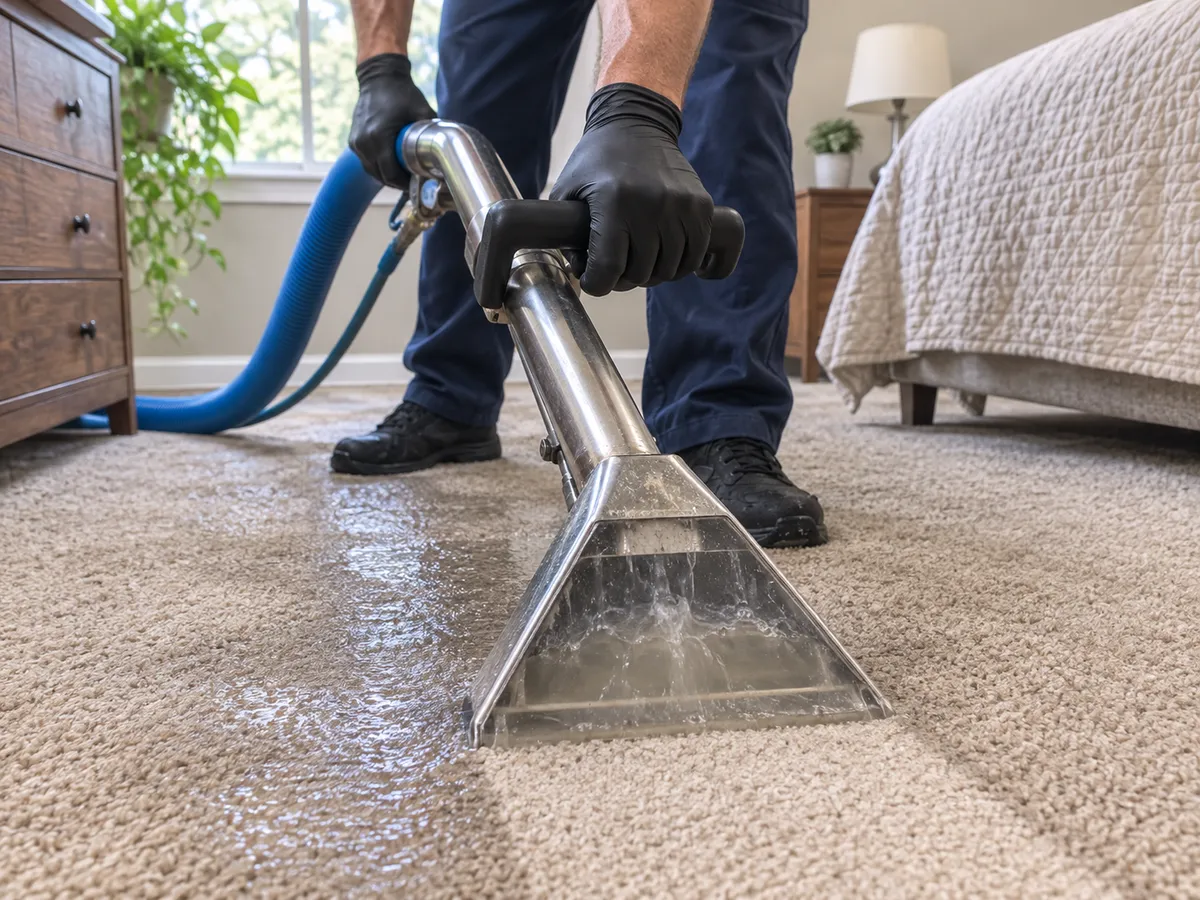
- Pump and extract. Pumps for deep water, extraction wands for carpet and pad, squeegees for tile.
- Set drying. Air movers and dehumidifiers go in once standing water is gone.
Do
- Photograph each room before anything is moved[FEMA].
- Lift furniture onto blocks or foil to protect legs and carpet.
Avoid
- Using a household vacuum on standing water.
- Walking through water near outlets or extension cords[CDC].
The water damage restoration process in Atascocita
Most restoration work in Atascocita runs through the same six stages, whether the water came from a split supply line or a flooded street.
- Inspection and moisture mapping. The technician confirms the leak is stopped, then maps how far the water traveled with moisture meters and infrared cameras.
- Water removal. Submersible pumps take out deep water, and extraction units pull water from carpet, pad and hard floors. Mechanical extraction removes water much faster than air drying can.
- Removal of what cannot dry. Soaked pad, baseboards, the lower part of wet drywall and wet insulation come out when they cannot be dried in place. Per the EPA flood cleanup guide, anything wet that cannot be fully cleaned and dried inside 24 to 48 hours goes[EPA flood cleanup guide].
- Structural drying. Air movers push air across wet surfaces while dehumidifiers pull the moisture out of the air. The EPA target is indoor humidity below 60 percent[EPA].
- Cleaning. Anything the water touched is cleaned. Items that cannot be disinfected, including wall coverings, cloth, rugs and drywall, should be thrown away, according to the CDC[CDC].
- Final readings. Equipment stays until moisture readings in the walls, subfloor and framing return to normal, and those readings are written down.
Drying time and what speeds it up
The EPA’s target is to dry wet materials within 24 to 48 hours[EPA]. A small clean-water leak caught early can often be dried in a few days. After a flood, the EPA warns that drying out can take several weeks[EPA flood cleanup guide].
Humid outdoor air works against you. The EPA’s guidance is to dehumidify when outdoor air is warm and humid, and to ventilate only when outside air is cold and dry[EPA]. On most days in Atascocita that means keeping windows closed and letting the dehumidifiers work.
Leave the equipment running, keep doors to the drying area closed, and let the technician move it. Turning off air movers at night to cut noise can add days to the job.
Sewage backups in Atascocita
A backup from a toilet, tub or floor drain is grossly contaminated water under the IICRC categories[IICRC 2026 position statement]. The area is closed off, contaminated porous materials come out, and surfaces are cleaned before any drying starts.
Clearing the line is plumbing work, or the utility’s job if the blockage is on its side. Cleanup of the house is the restoration company’s job.
Before you go back into a flooded home
Turn around at flooded roads. Six inches of fast-moving water can knock an adult down, and 12 inches of rushing water can sweep away most cars, according to the NWS[NWS].
With water in the house, turn off power at the breaker if you can do it safely, and disconnect appliances before power is restored[CDC]. Document the damage with photos before anything is moved[FEMA].
What usually causes water damage in Atascocita
- Supply lines. Braided and plastic supply lines under sinks and toilets fail at the connection. A failed line can run at full pressure until the valve is closed.
- Water heaters. When the tank or fittings leak, water spreads across the slab from the garage, closet or utility room.
- Washers. Old rubber hoses split, and a washer drain that backs up puts dirty water on the floor.
- Air conditioning. Condensate lines clog and drain pans overflow, especially in long cooling seasons.
- Kitchen appliances. Ice maker lines and dishwasher hoses leak out of sight under the cabinets.
- Weather. Heavy rain, roof leaks and street flooding. Wind-driven rain that is contaminated counts as Category 3 water[IICRC 2026 position statement].
Knowing the source tells the crew what category the water is and where to look for spread.
Emergency water removal and Atascocita homes
Much of the housing is recent. 38% of homes in the Atascocita census-designated place were built in 2010 or later, with a median year built of 2006[U.S. Census Bureau]. Newer homes still have supply hoses, water heaters and drain lines that can fail.
Water and sewer service around Atascocita comes from local utility districts rather than a single city department. The Texas PUC water utility search lets you look up the provider by name or county[Texas PUC water utility search], and the district’s number is on your water bill.
More in Atascocita
- Water extraction in Atascocita
- Water mitigation in Atascocita
- Water damage cleanup in Atascocita
- Flood restoration in Atascocita
- Flood cleanup in Atascocita
- Sewage cleanup in Atascocita
- Burst pipe water damage in Atascocita
- Crawl space water removal in Atascocita
- Water damage restoration in Atascocita
Emergency water removal nearby
- Emergency water removal in Humble
- Emergency water removal in Houston
- Emergency water removal in Pearland
General guide: emergency water removal explained.