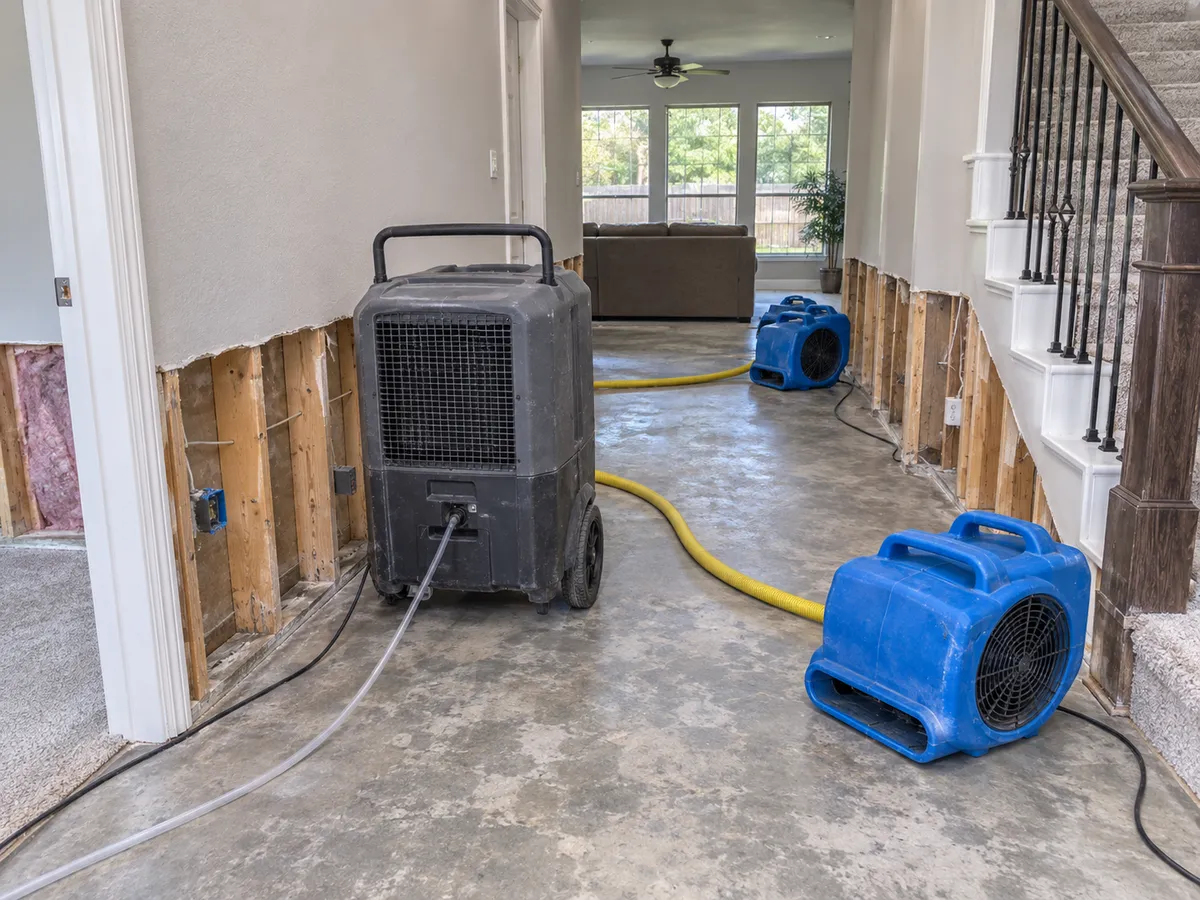
Close the main valve, keep away from wet electrical equipment, take photos[FEMA], and get drying started; the EPA puts the window at 24 to 48 hours[EPA].
Emergency water removal for Huffman homes
Water damage restoration in Huffman begins with water removal. Pumps handle deep water, and extraction units pull water from carpet, pad and tile so the drying equipment can do its job. On a slab foundation, water spreads under walls into nearby rooms, so crews check moisture beyond the room where the leak started.
Next is mitigation and structural drying. Materials that cannot be dried in place come out, and air movers and dehumidifiers run until readings show the structure is dry. EPA guidance is to keep indoor humidity under 60 percent[EPA], and the CDC recommends fans and dehumidifiers to help[CDC].
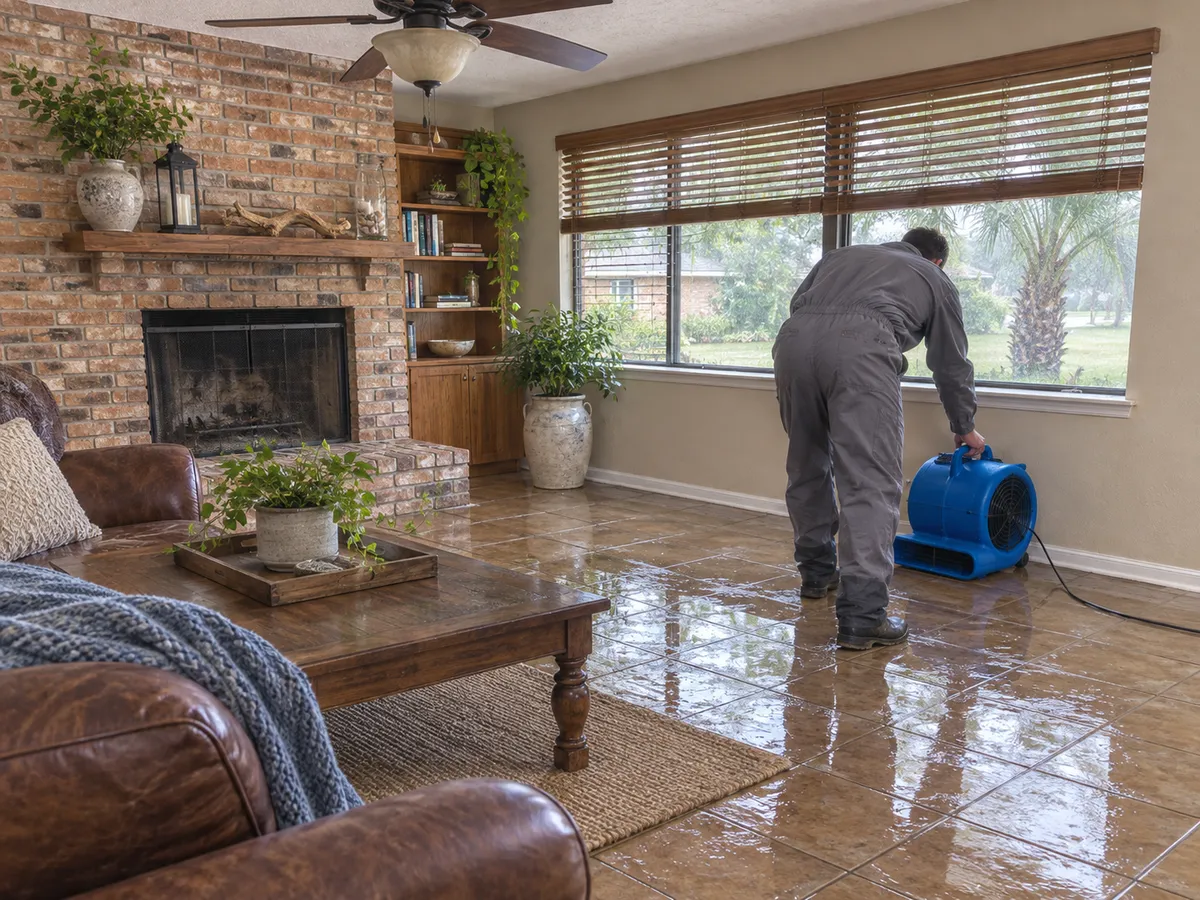
How a water damage cleanup runs in Huffman
- Stop the source. Close the main shut-off or the fixture valve.
- Document. Photos and video before anything moves[FEMA].
- Extract. Standing water out of floors, carpet and pad.
- Dry and verify. Equipment runs until moisture readings are normal.
Inside a water damage restoration job in Huffman
Water damage restoration is more than pulling up wet carpet. A typical job in Huffman moves through six stages, and skipping one is how hidden moisture gets left behind.
- Inspection and moisture mapping. Moisture meters and thermal cameras trace water under flooring, inside walls and in ceilings, and the crew confirms the source is stopped.
- Water removal. Standing water comes out first, with pumps for deep water and extraction wands for carpet and tile, so drying equipment is not fighting a puddle.
- Removal of what cannot dry. Materials that will not dry in time are cut out. The EPA flood guide draws the line at 24 to 48 hours: if a wet material cannot be cleaned and dried by then, it is tossed[EPA flood cleanup guide].
- Structural drying. Air movers push air across wet surfaces while dehumidifiers pull the moisture out of the air. The EPA target is indoor humidity below 60 percent[EPA].
- Cleaning. Anything the water touched is cleaned. Items that cannot be disinfected, including wall coverings, cloth, rugs and drywall, should be thrown away, according to the CDC[CDC].
- Final readings. Equipment stays until moisture readings in the walls, subfloor and framing return to normal, and those readings are written down.
What usually causes water damage in Huffman
- Water heaters. Tanks rust through at the bottom, and relief valves and supply connections drip. Check the floor or drain pan under the tank.
- Washing machine hoses. Rubber supply hoses crack with age and can release water at full line pressure until someone closes the valve.
- Toilets and supply lines. A failed fill valve, cracked tank or loose supply line can run for hours, often while nobody is home.
- AC condensate. A clogged drain line backs up the drain pan, and the overflow lands in the ceiling below or on the floor around the air handler.
- Refrigerators and dishwashers. Ice maker lines and dishwasher connections leak slowly under cabinets, where the water can sit for weeks.
- Storms and roof leaks. Wind-driven rain gets in around flashing, vents and windows, and the IICRC treats contaminated wind-driven rain as Category 3[IICRC 2026 position statement].
The source matters because it sets the water category and the starting point for moisture mapping.
Clean water, gray water and sewage: the three categories
The IICRC splits water into three categories. Category 1 is clean water from a source like a burst supply line. Category 3 is grossly contaminated, and the IICRC lists sewage, waste line backflows from beyond a trap, seawater flooding, rising rivers or streams and contaminated wind-driven rain as examples[IICRC 2026 position statement]. Category 2 sits in the middle.
It also changes how the crew works. With Category 2 or 3 water, removal and cleaning happen first, under contamination controls, and drying comes after; Category 1 can go straight to drying[IICRC 2026 position statement]. Floodwater from a Huffman creek or bayou is Category 3.
Time matters too. The IICRC notes that time and temperature can change the category[IICRC 2026 position statement], so a clean leak left sitting in a warm house can be treated as contaminated water a few days later.
Leaks you cannot see in a Huffman house
Most homes around Huffman are built on concrete slabs, so water does not drain into a crawl space. It spreads sideways under baseboards, cabinets and flooring into the next room. That is why the wet area on the meter is often larger than the wet area you can see.
The AC system is easy to overlook. A clogged condensate line backs up the drain pan, and the EPA says pans that do not drain can let water into the HVAC system[EPA]. Keep the pan clean and the line flowing[EPA], especially when the unit is in the attic over finished rooms.
Places to check:
- Inside walls around leaking or sweating pipes[EPA]
- Under vinyl plank, laminate and carpet pad
- Behind the refrigerator ice maker line and dishwasher
- Under the water heater and washing machine
- Wall surfaces behind furniture, where condensation forms[EPA]
- Roof materials above ceilings after a roof leak[EPA]
Warning signs include a musty smell, swollen baseboards, peeling paint, flooring that lifts or cups, and a water bill that jumps with no change in use.
What the restoration crew brings
- Pumps and extractors. Submersible pumps remove deep water. Extraction wands and weighted tools pull water out of carpet and pad.
- Air movers. Fans set at angles along walls and floors move air across wet materials.
- Dehumidifiers. Remove water from the air. Without them, air movers just push humid air around the room.
- Moisture meters. Measure the water in drywall, framing and subfloor, and confirm when each area is dry.
- Infrared cameras. Help locate wet areas behind finished surfaces, with meters used to confirm.
- Containment. Plastic sheeting closes off the work area, which keeps contaminated water and drying air where they belong.
Drying time and what speeds it up
The EPA’s target is to dry wet materials within 24 to 48 hours[EPA]. A small clean-water leak caught early can often be dried in a few days. After a flood, the EPA warns that drying out can take several weeks[EPA flood cleanup guide].
Opening the windows rarely helps here. EPA guidance is to dehumidify when the outdoor air is warm and humid and to increase ventilation only when it is cold and dry[EPA], and warm, humid air is the norm in Huffman for much of the year.
Leave the equipment running, keep doors to the drying area closed, and let the technician move it. Turning off air movers at night to cut noise can add days to the job.
What can be saved and what usually goes
The deciding factors are the type of water and how long things stayed wet. Under the EPA flood guide, if something cannot be cleaned and made dry inside a day or two, it is discarded[EPA flood cleanup guide], and the CDC adds that items which cannot be disinfected, such as wall coverings, cloth, rugs and drywall, should be thrown away[CDC].
Clean-water losses give you more options. The EPA says drywall, fiberglass insulation and carpet soaked only with clean water can sometimes be dried and kept, but it also suggests considering replacement because they dry slowly[EPA flood cleanup guide].
Take photos and video of damaged items before they are removed[FEMA].
When a storm knocks out power in Huffman
Beryl came ashore near Matagorda on July 8, 2024 as a Category 1 hurricane with 80 mph winds, dropping around 4 to 8 inches of rain on average and 10 to 15 inches in some swaths[NWS]. CenterPoint’s tracker showed more than 2.2 million homes and businesses without power[Houston Public Media].
Drying equipment runs on power. When the grid is down, a soaked house sits in heat and humidity, so ask whether the restoration company can bring generator power for its equipment.
If you use a generator, keep it outdoors, at least 20 feet from doors, windows and vents, never in the garage, and run a battery carbon monoxide detector inside[CDC]. Carbon monoxide caused two indirect deaths after Beryl[NWS].
Sewage backups in Huffman
Sewage is Category 3 water[IICRC 2026 position statement]. Keep children and pets out of the area, do not run fans that blow air from the wet room into the rest of the house, and do not try to dry it in place. Soaked carpet, pad and drywall are removed and the area is cleaned and disinfected before drying.
Clearing the line is plumbing work, or the utility’s job if the blockage is on its side. Cleanup of the house is the restoration company’s job.
Frozen and burst pipes
Hard freezes are rare here, which is why they cause so much damage. In February 2021 the National Weather Service recorded 13°F in the city of Houston[NWS Houston/Galveston], and pipes in attics and exterior walls split across the region.
A frozen pipe often does not leak until it thaws. Know where your main shut-off is before a freeze, and if a pipe splits, close the main first and then call. Water from a burst supply line starts as Category 1, so fast extraction and drying can save more of the house.
What to ask before work starts
- Which IICRC category does this water fall into?
- Can you show me the moisture readings and the wet area on a sketch?
- Which materials are coming out, and which can be dried in place?
- When will you take readings, and when do you expect the job to be dry?
- Do I need a plumber to stop the source first?
- Will you put the scope of work in writing before you start?
A good restoration company will answer these without hesitating and will take readings before giving a plan.
Before you go back into a flooded home
Turn around at flooded roads. Six inches of fast-moving water can knock an adult down, and 12 inches of rushing water can sweep away most cars, according to the NWS[NWS].
If there is standing water inside, be ready to turn off the power, and unplug appliances so they do not shock anyone when power returns[CDC]. Take photos and video of every room before cleanup starts[FEMA].
Once the house is dry
Keep the final moisture readings and the drying log with your photos. Check the area again over the next few weeks for odors, stains or swelling, which can mean water was missed. The EPA notes that cleanup is not finished until the water or moisture problem itself is fixed[EPA].
About Huffman: homes, water and flooding
- 5,340
- housing units
- 1996
- median year built
- 78%
- owner-occupied
- 35.663 sq mi
- land area
In ZIP code 77336, the Huffman postal area, 69% of the 5,340 housing units are detached single-family homes, and owners live in 78% of occupied units[U.S. Census Bureau]. The median home in ZIP code 77336, the Huffman postal area was built in 1996, and 38% went up between 1990 and 2009[U.S. Census Bureau]. At that age, original water heaters, supply hoses and shut-off valves are often due for attention.
During Hurricane Harvey, the National Weather Service logged 31.80 inches of rain at the 3 N Huffman gauge between August 25 and 31, 2017[NWS Houston/Galveston]. Any address in Huffman can be checked against the FEMA flood map[FEMA Flood Map Service Center]. Harris County homeowners can also use the Flood Control District’s Flood Education Mapping Tool, which shows mapped floodplains relative to homes[Harris County Flood Education Mapping Tool].
Luce Bayou flows past Huffman into Lake Houston. During Tropical Storm Imelda in September 2019, the Harris County Flood Control District reported significant flooding along Luce Bayou from its headwaters in Liberty County to Lake Houston, with structure flooding upstream of FM 2100; 48-hour rain totals averaged 20 to 30 inches from Crosby to Huffman[Harris County Flood Control District]. Harvey remains the flood of record on Luce Bayou[Harris County Flood Control District].
Water and sewer service around Huffman comes from local utility districts rather than a single city department. The Texas PUC water utility search lets you look up the provider by name or county[Texas PUC water utility search], and the district’s number is on your water bill.
Nearby
Atascocita, Humble and Spring have their own pages. See every city on the Harris County page.