How water extraction works in Humble
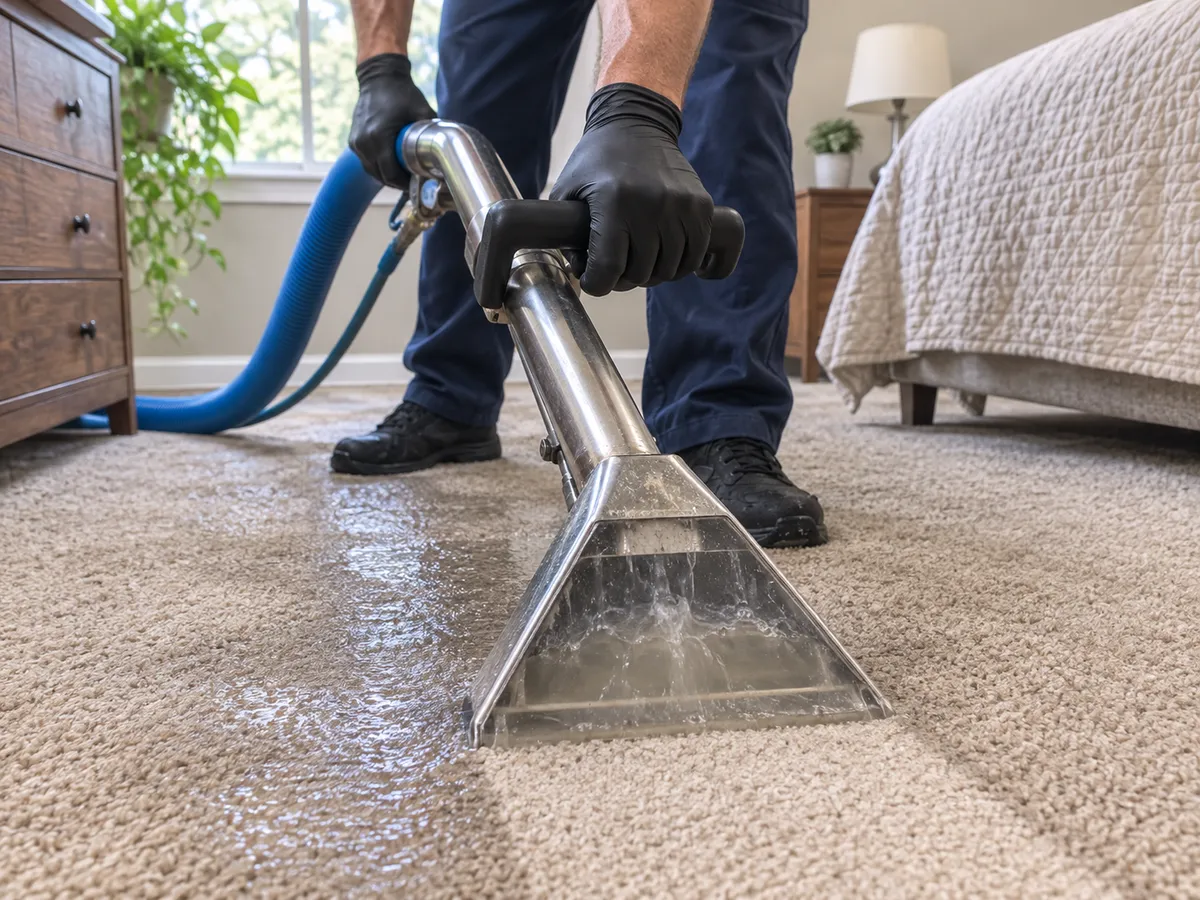
Fans cannot dry a floor that is still holding water. Water extraction in Humble uses weighted extraction tools on carpet, wands on hard surfaces and pumps for deep water, which removes far more water than evaporation alone.
Carpet pad acts like a sponge and is often pulled and discarded after extraction, while the carpet itself may be dried in place if the water was clean. The EPA’s drying window of 24 to 48 hours is the target for everything that stays[EPA].
Step by step
- Source off. Water shut off at the main or fixture.
- Extract. Carpet, pad and hard floors extracted until little water comes up.
- Pull pad if needed. Soaked pad is removed so the slab can dry.
- Dry and measure. Equipment runs until readings show dry.
Do
- Keep foot traffic off wet carpet.
- Move rugs and loose items off wet floors.
Avoid
- Leaving wet rugs folded on the floor.
- Running the heat to “dry things out” with doors closed.
Hidden water: the spots crews check first
On a slab foundation, which is common around Humble, water moves outward under walls and cabinets instead of draining down. A leak in a hall bath can show up as a damp closet two rooms away.
The AC system is easy to overlook. A clogged condensate line backs up the drain pan, and the EPA says pans that do not drain can let water into the HVAC system[EPA]. Keep the pan clean and the line flowing[EPA], especially when the unit is in the attic over finished rooms.
Places to check:
- Water heater pans and the floor around them
- Washer supply hoses and the wall behind them
- Sink cabinets and the subfloor under them
- Inside walls around pipes that leak or condense[EPA]
- Inside ductwork[EPA]
- Under flooring next to tubs, showers and toilets
Watch for a damp smell, baseboards that swell, stains that grow, floors that cup or buckle, and a water bill higher than normal.
Storm season, outages and generator safety
Beryl came ashore near Matagorda on July 8, 2024 as a Category 1 hurricane with 80 mph winds, dropping around 4 to 8 inches of rain on average and 10 to 15 inches in some swaths[NWS]. CenterPoint’s tracker showed more than 2.2 million homes and businesses without power[Houston Public Media].
Drying equipment runs on power. When the grid is down, a soaked house sits in heat and humidity, so ask whether the restoration company can bring generator power for its equipment.
Generator safety: never run a generator inside the home or garage, keep it at least 20 feet from windows, doors and vents, and use a battery-powered carbon monoxide detector[CDC]. After Beryl, the NWS counted two indirect deaths from carbon monoxide poisoning[NWS].
Questions to ask the restoration company
- Which IICRC category does this water fall into?
- Can you show me the moisture readings and the wet area on a sketch?
- Which materials are coming out, and which can be dried in place?
- When will you take readings, and when do you expect the job to be dry?
- Do I need a plumber to stop the source first?
- Will you put the scope of work in writing before you start?
Clear answers to these questions are a good sign. So is a technician who takes readings before quoting.
Flood safety first
Do not walk or drive through floodwater. The National Weather Service says 6 inches of fast-moving water can knock over an adult and 12 inches of rushing water can carry away most cars[NWS].
With water in the house, turn off power at the breaker if you can do it safely, and disconnect appliances before power is restored[CDC]. Document the damage with photos before anything is moved[FEMA].
Once the house is dry
Ask for a copy of the final readings and keep them with your damage photos. In the weeks after, watch for a damp smell, new stains or swelling floors. Fix the source for good; the EPA is clear that the water problem must be fixed or it comes back[EPA].
Water extraction and Humble homes
The Census Bureau counts 6,428 housing units in the city of Humble; 42% are single-family detached houses and 39% of occupied homes are owner-occupied[U.S. Census Bureau].
Housing here skews older: 44% of homes in the city of Humble were built before 1980, and the median year built is 1982[U.S. Census Bureau]. Older supply lines, drain lines and water heaters are common sources of leaks.
More in Humble
- Emergency water removal in Humble
- Water mitigation in Humble
- Water damage cleanup in Humble
- Flood restoration in Humble
- Flood cleanup in Humble
- Sewage cleanup in Humble
- Burst pipe water damage in Humble
- Crawl space water removal in Humble
- Water damage restoration in Humble
Water extraction nearby
General guide: water extraction explained.